Here's some of the cool gaming stuff that is being shown off at CES right now. I will be reporting it to you as soon as I can steal it from other news sites who are lucky enough to actully be there to play with the stuff.
RAZER PC MOTION CONTROLLER
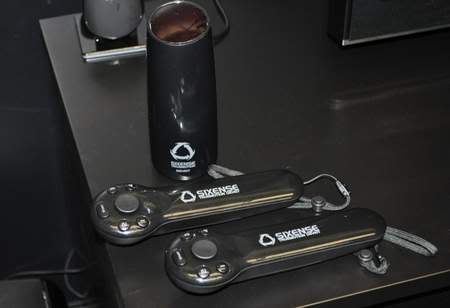
While the most popular new user interface controls, like Microsoft’s Project Natal and Sony’s Magic Wand, failed to show up at CES for the press to see, Razer made a final announcement that will push the boundaries of today’s motion controllers. Using magnetic technology (which is much simpler and significantly more accurate than accelerometers currently supported by Nintendo, Sony and many others) Razer teamed up with Sixense Entertainment to produce the first 1:1 motion controllers for the PC.
These controllers—currently in the form of two handheld controllers in the shape of Nintendo’s Nunchuk addition to the Wii remote--offer the same great gameplay that we see on Nintendo’s console with none of the errors or readjustments. The demo we viewed was of Left 4 Dead 2 being played with these controllers in several different ways, as a standard mouse with motion functions (such as pushing by literally pushing outward or using melee attacks by swinging the controller around) to more touch-based designs like aiming around a stationary screen and turning--similar to Metroid Prime 3, where the closer the crosshairs get to the edges, the faster the screen turns.
This technology, while still in its rudimentary stages, clearly makes Nintendo’s previously flawless Wii remote look like a child’s toy. Not only does it have all the same functions with less hardware and cost to Razer per remote, it is also completely programmable. The demonstration included playing Left 4 Dead 2 with and without push controls, so gamers who like aiming but don’t like the more forceful actions motion-based games typically employ can play with this new controller without issue. Valve has already provided support for the product, and we can see why: it’s extremely promising, and we can’t wait to hear more about it.
***
Psyko Audio 360 5.1 Headset
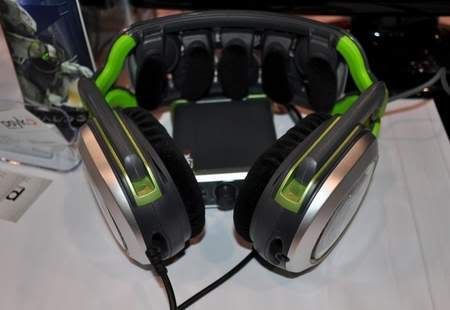
Made specifically for the console (though functional on the PC as well), this is a huge step forwards for surround sound 360 gaming. Our previous look at the technology Psyko Audio employs for their headset proved not only more efficient but more realistic than other simulated technologies, and having that audio quality coming to consoles is exciting, to say the least.
***
Alienware M11x
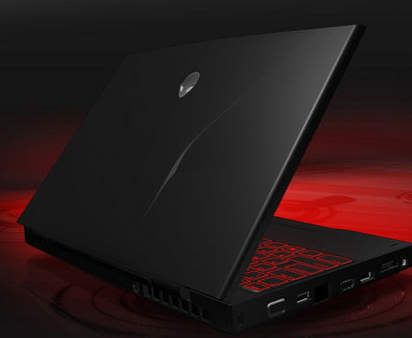
Now, Alienware has shown off the M11x, an 11.6-inch laptop built specifically for gaming on a budget. Small but heavy, this netbook-sized machine seems to laugh in the face of similarly sized machines, easily playing Call of Duty: Modern Warfare 2 at 720p, its small screen’s resolution.
It’s fun to watch this little netbook-sized machine playing full games on its Core 2 Duo processor and Nvidia 335m GPU. And starting at under $1000, it’s basically every gamer’s dream: a small gaming laptop that won’t break the bank, or your back on the road.
***
Peregrine Glove
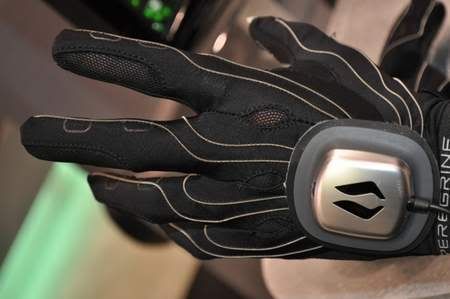
After over two years of development, the Peregrine glove controller is finally in its final steps and ready to hit the market by the end of January. This glove allows users to activate at least thirty different functions by simply by gesturing with their fingers. Control over functions is accomplished by touch sensitive parts on the glove, though with the added software, players can combine these settings and easily have tens of various in-game functions available to them at a moment’s notice. While we don’t see any real use for Peregrine outside of MMO (Massively Multiplayer Online) gaming and specialized applications, it’s an interesting idea that, if it proves reliable, may help shape the future of touch gaming.
***
Acer HD 3D Monitors
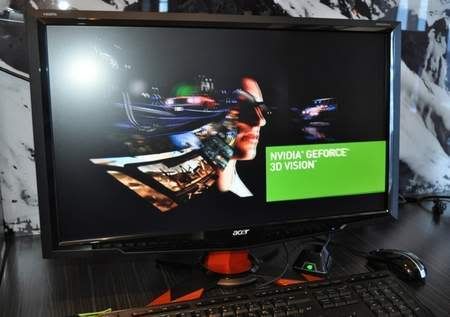
As many of you know, this year’s CES is will be remembered as “that year we got 3D in everything.” Surprisingly, 3D gaming has been around for over a year, but only within the last few days have we seen anything specifically about PC monitors capable of 3D viewing at full HD (1920 x 1080). Until now, both announced 3D monitors have been 22-inch displays with resolutions of 1680 x 1050.
Both Acer and Alienware introduced their own 3D displays, at 23.6-inches and 23-inches respectively, and both have full HD resolutions. Thankfully, these 120Hz displays won’t cost too much. Current pricing is $400 and $500 respectively, with the Alienware machine touted specifically for gamers. It includes a four-pronged USB hub. For serious PC gamers who enjoy 3D gaming, this is the next step you’ve been waiting for.
***
Nyko PS3 Media Hub
PlayStation 3 owners who enjoy watching either DVDs or Blu-ray discs on their consoles have been forced to use the standard controller, or pony up another $30 for the Bluetooth media remote, which only works with the PS3. While Xbox 360 owners have the luxury of purchasing a similar remote for their consoles, that one uses standard IR and can act as a universal remote. Too bad for PS3 owners.
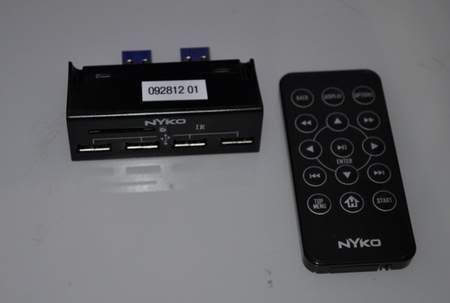
Nyko, which makes peripherals for all the gaming consoles, offers a partial solution to this predicament with its latest media hub, which is made specifically for the latest generation of PS3 consoles. The new PS3s offer only two USB ports, but Nyko’s media hub includes four, plus an SD card reader, and an IR sensor. With a small media remote, you can control movie playback like you would on a standard remote control, even if it’s just a tiny little device. No word yet if it works with TVs, but we’ll know more about it in the coming months.
***
Nyko Wand+
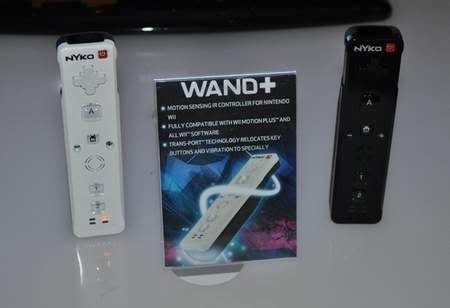
Like the Wii Motion Plus attached to the Wii remote, Nyko’s Wand+ features both accelerometer and 1:1 motion control, so it can coordinate your movements on screen identically to Nintendo’s add-on. It does this without the need to add in another in and requires no extra care or handling. Like the older Wand, identical to the Wii Remote, the Wand+ has larger and easier to press buttons while using the same double-A batteries and being almost identical in weight and size. The Wand+, in fact, is lighter than Nintendo’s remote because it’s all packed into one device. The best part? It’s set to release for $50, the same price as your typical Wii remote without the Motion Plus add-on.
***
Razer Chimaera Surround Headset
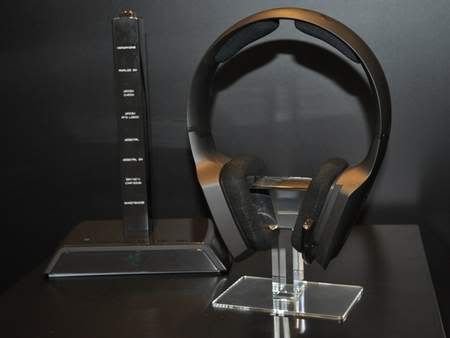
Fans of Razer already know the company is lauded for its vast array of high-quality mice, as well as other gaming peripherals like keyboards and headsets. At CES, the company revealed its first steps into console gaming, first with the Chimaera surround sound gaming headset, and then with the Onza gaming controller (see page 6).
This surround-sound/chat headset, while still under development, is currently designed for use on the Xbox 360 and PC. A removable boom microphone connects via standard 3.5mm audio jacks, or into the 360 controller’s 2.5mm connector. While we’ve seen such headsets in the past from Tritton and Turtle Beach, this is Razer’s first step towards console gaming. The headset is rechargeable and comes with a charging base, though the company still has to decide whether it will be strictly for the PC and 360, or if it will be PlayStation 3-compatible as well.
***
Razer Onza 360 Controller
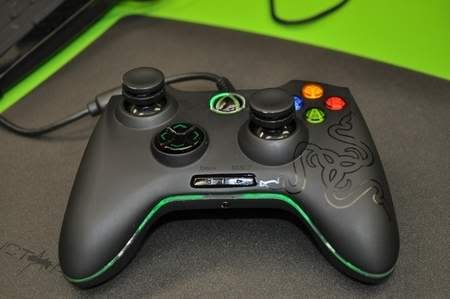
Razer’s second step towards console gaming is its own wired controller. Like Madcatz, Nyko and a plethora of other third-party controller manufacturers, the company has no access to Microsoft’s wireless technology, but instead Razer prefers a wired connection. Because so many Razer-faithful practically demand a tournament-level controller, speed and accuracy are necessary qualities, and that means no lag time, including the lag time associated with a wireless connection.
The biggest difference between the Onza and today’s standard 360 remotes is the inclusion of two more bumpers, between the first bumper and trigger on both the right and left. These bumpers are completely programmable keys and can duplicate the function of any button on the controller, which is extremely desirable for many titles, especially those which require pressing the thumbstick buttons often, while moving in-game. There is also a rapid-fire function, which is not allowed for use online over Xbox Live. Onza is still in development and will undergo plenty of changes and refinement before it hits the market.
***
Madcatz Cyborg R.A.T. Gaming Mice
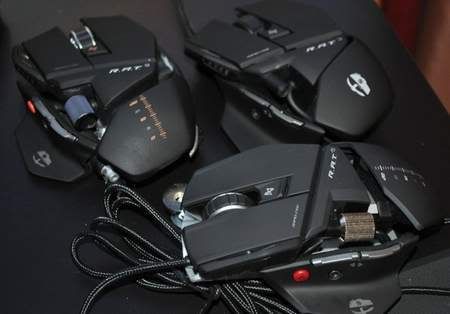
Last year, Madcatz proved that it wasn’t all about quantity over quality with the Street Fighter IV fightsticks. This year, the company is pushing the point home with the R.A.T. gaming mice. In four varieties, the R.A.T. mice are customizable gaming mice made to ensure all gamers are happy.
The R.A.T. 3 is a basic gaming mouse, with 3200DPI for $50. The R.A.T. 5 is $70, and has adjustable length and weight, as well as programmable functions. The R.A.T. 7 has all that, a 5600DPI laser and is fully adjustable for $100, while the R.A.T. 9 is a R.A.T. 7 with two rechargeable batteries. These mice may not look like much, but the adjustable size and weight gives users complete control of the feel of each mouse, going so far as to include a wing for the right side should gamers find their fingers dangling.
Saitek’s previous gaming mouse proved more comical than serious with its built-in mechanical extender (which made the mouse “grow” an extra 15mm), but the R.A.T. pack is all adjustable by hand.
***
Nvidia GF100
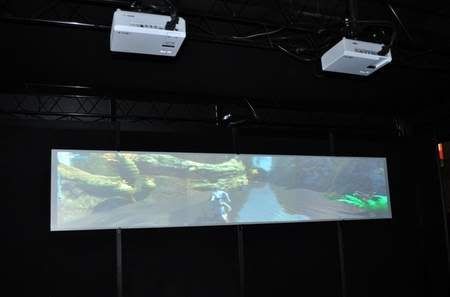
ATi previously exposed the world to the 5870, the company’s top of the line card that ran on six monitors simultaneously. At CES, Nvidia naturally had to compete. The company revealed that its new Fermi architecture produced the GF100--a brand new GPU that can process (at full HD) three monitors, all running in 3D.
Running any game in 3D takes roughly twice the processing power as it takes to run normally, so running three monitors in 3D is nearly identical to running six monitor independently. Currently, Nvidia doesn’t have benchmarks to share, but the company states that, theoretically, it should run six monitors just fine. We’ll have to find out and see for ourselves, but the claim is that the GF100 blows all the competition out of the water. Look out ATi?
***
Will post more as I get it.